

In our last post, we talked about how we have to look outside the walls of our schools themselves to see the real-life responsibilities and daily life disruptions that can keep a student from making it to class. That conversation brings us to an important realization- if we want to turn these numbers around, we have to go beyond the notice.
We have to approach families and communities with far more than just the automated text or letters sent home telling them their student is missing too much school. Because when it comes down to it, chronic absences are almost never as simple as a kid just choosing to stay home. Instead, in many cases, it represents a much bigger, messier challenge happening before they even get there.
Adding to the complexity is the fact that these root causes can look completely different depending on a student’s age. A kindergartener might miss school because a parent is caught in unpredictable work shifts, transportation challenges, or a sudden lack of childcare. They might just be catching every new classroom germ, or maybe their parents underestimate how quickly a couple of missed days here and there can snowball into a real attendance problem. But for an older student, that empty seat may be a symptom of trying to balance adult responsibilities—like working a job to help support the family, staying home to care for younger siblings, or working through social and emotional challenges.
What’s clear and makes chronic absenteeism more complex—it’s not just a school problem, and it’s not just a family problem—it’s a community-wide issue that impacts all of us. When our students become disconnected from school, it impacts our neighborhoods and our future workforce and could be a warning sign that our community’s safety nets may be failing. As we shared in our previous posts, we have great systems for flagging when a student is absent, but they can’t tell us why. To help us better understand the stories behind the data, we’ve brought in a special guest consultant for this post. Marsha VanHook, a Program Specialist with the Kentucky Department of Education, is a leader in efforts to build and support these exact community and family partnerships.
Marsha emphasizes that we can’t use a cookie-cutter approach here. Every single neighborhood is different:
“Each community is unique in its very make-up. This uniqueness brings with it a specific set of barriers, challenges and potential partnerships to engage in the overall well-being of the community. Schools may be just a few miles apart and yet have completely different needs. This makes finding a “one-size fits all” solution to reducing chronic absenteeism a tall order.”
Shifting the Mindset: Involvement vs. Engagement
To get to the bottom of these unique needs and potential root causes, Marsha emphasizes that schools have to change how they approach parents, requiring a major shift from simply involving families to truly engaging them. She suggests we think of it as moving away from doing things “to and for” families, and instead doing things “with” them. Here is how she breaks down the difference:
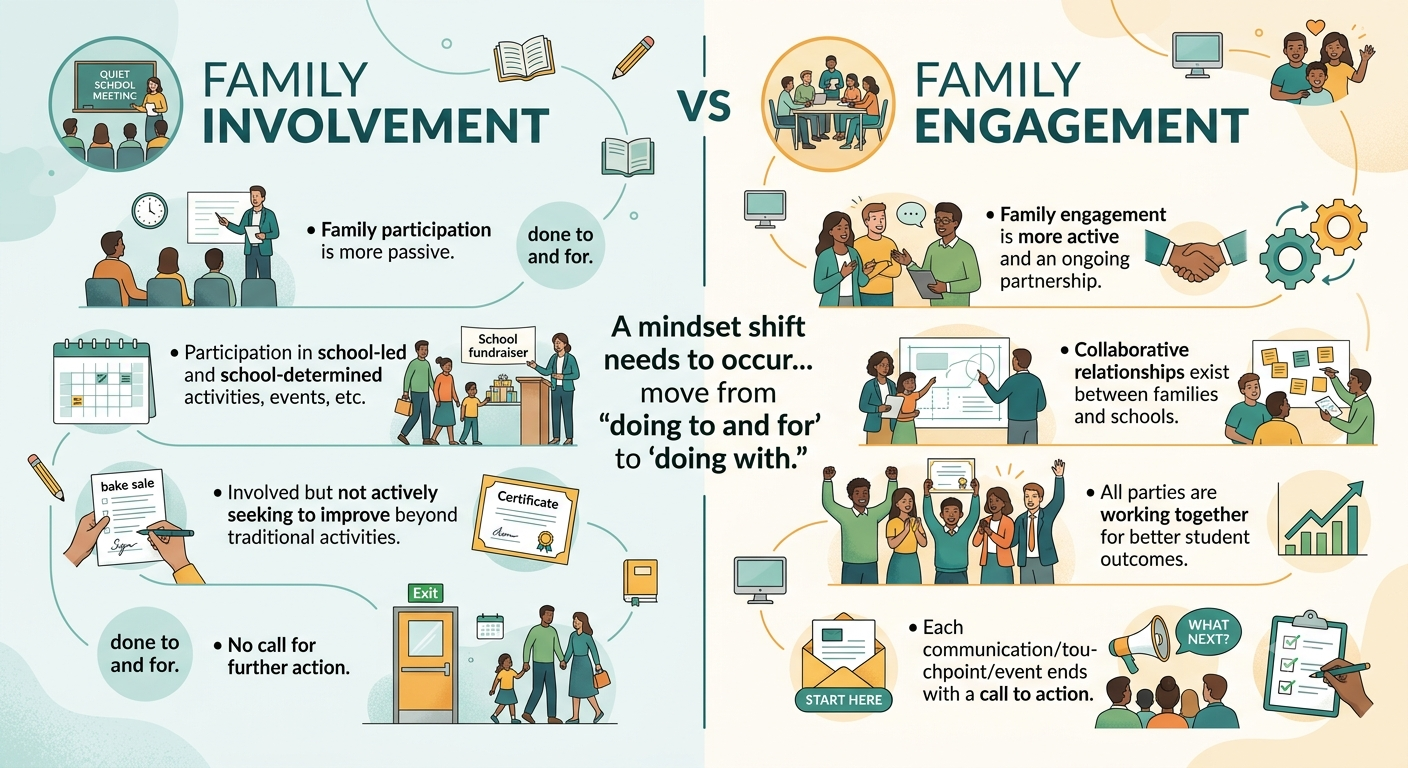
Infographic layout and illustrations assisted by AI.
Community and Family as Partners
Marsha goes on to share how school leaders often think they know what their community needs from its schools, but without real conversations, they might just be checking compliance boxes. She suggests asking questions like “How can we be sure we are meeting the needs of our families?” leads to rich dialogue around the actual needs, barriers and challenges that our families are facing, which too often become a contributing factor to chronic absenteeism. Examining data together she says provides clues, answers and partnership opportunities that might not have been apparent to school leaders alone without the community and family voices.
But where and how do we start to have those collaborative partnerships and shared conversations? Marsha explains that just knowing how to start can be a barrier for the school itself and points to a few incredible, data-backed tools available right here in Kentucky to help bridge that gap:
- The Kentucky Family and School Partnership Guide: One of the fundamental building blocks to transforming to true community and family partnerships is building trusting relationships. Created by the Kentucky Collaborative for Families and Schools and formerly called The Missing Piece of the Proficiency Puzzle, this guide is designed to assist schools and district groups in working more effectively together to become proficient overall in the practice of family engagement.
- The Family Engagement Digital Playbook: A highly practical, age-indexed tool focused on five key areas (Relationship Building, Communication, Shared Responsibility, Advocacy, and Community Partnerships), giving schools communication tips and “10 Easy Wins” they can implement right away. The playbook is a rich resource to begin or expand collaborative partnerships with families.
The Power of Showing Up Together
Marsha further backs up the approach with highlights from several studies, including a 2023 study by Learning Heroes and The New Teacher Project (TNTP) that found the relationship between family engagement and chronic absenteeism is so powerful, it might actually be stronger than the effect of poverty.1
In fact, the study showed schools with stronger family engagement saw academic improvements comparable to adding 114 additional days of learning in reading and 96 days in math. When families feel valued, students do better, stay in school longer, and actually like school more.2
Research from The New Wave of Evidence found, “When schools, families, and community groups work together to support learning, children tend to do better in school, stay in school longer, and like school more.”3 The findings show that the benefits stretch beyond reducing chronic absenteeism. Schools that successfully engage families in education, regardless of ethnic, racial, or socioeconomic background, have students who are more likely to attend school regularly, earn higher grades or test scores, pass courses, earn credits, and be promoted. When families are engaged, their students also enroll in more advanced coursework, graduate from high school and attend post-secondary education, and have better social skills and classroom behavior.
Tools You Can Use Right Now
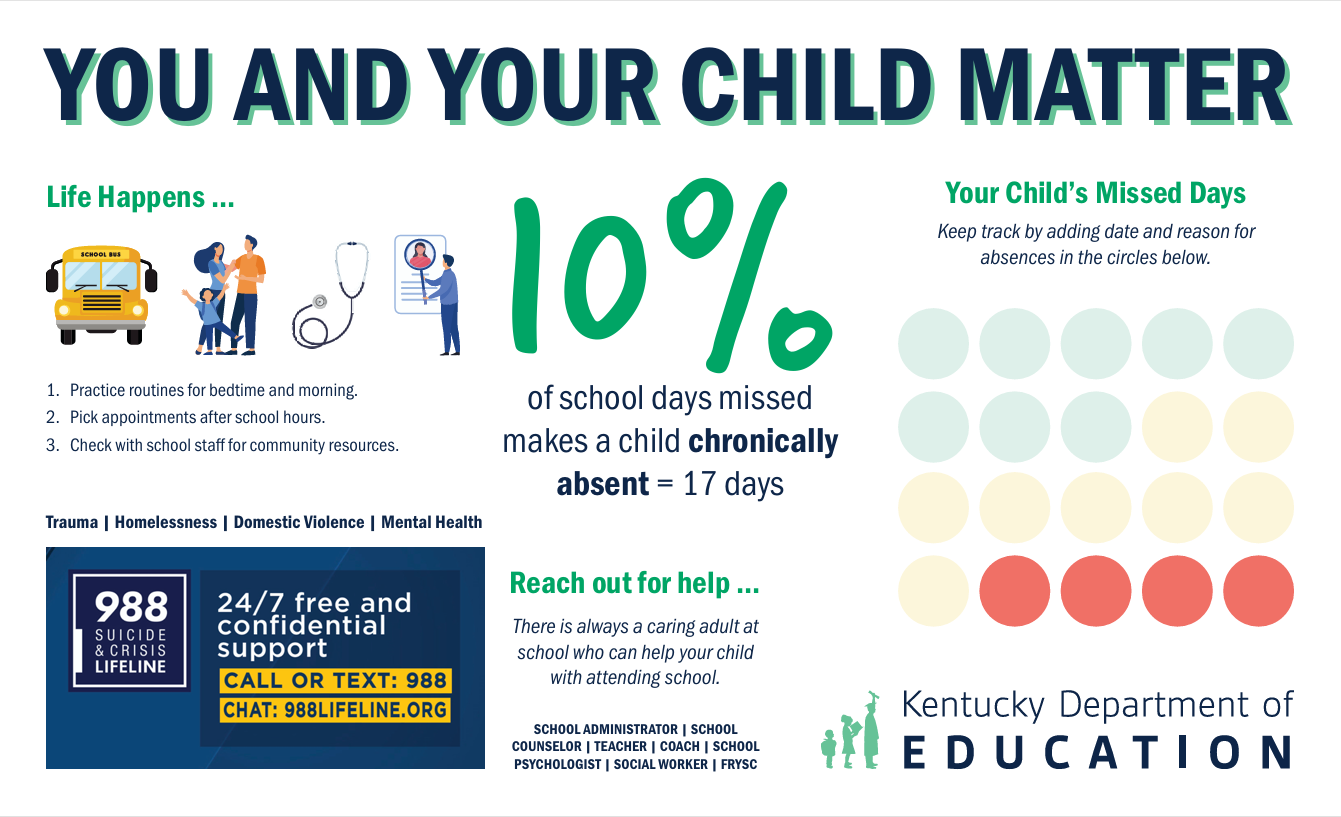
So, what does this look like in practice? Marsha recommends focusing on clear, positive, two-way communication. A great example is the Attendance Matters: You Belong! campaign we’ve discussed before. Inside that resource, you will find the You and Your Child Matter chart where students can track their own absences as they move along a predetermined color-coding system of green-yellow-red dots showing their individualized attendance. Progressing through the color dots indicates their own path to becoming chronically absent. This has proven to be an effective tool in empowering students to monitor and track their own attendance. Stories from the field indicate students are hesitant to move into the yellow category as this moves them further on the path to becoming chronically absent.
The Bottom Line
Marsha is quick to point out that creating authentic family and community partnerships does not happen overnight; it takes a mindset shift and commitment to transformation. She reminds us there are resources and districts/schools across the Commonwealth deeply involved in this work who are more than willing to share their insights and lessons learned in their transformation journey.
This brings us to the final piece of our puzzle. We’ve looked at the data, uncovered some real-life barriers our students face, and explored how true family engagement can completely change the game. But how do we tie all of this together into a lasting, community-wide strategy?
Marsha reminds us that the best solutions start with real, open dialogue—not just checking boxes. So, we want to hear from you.
Join the Conversation
What is one small, practical step your school or community has taken (or could take) to move from just “involving” families to truly “engaging” them? Drop your thoughts, experiences, or ideas in the comments below. Let’s keep this conversation going and learn from each other!
Coming Up in the Series
Stay tuned for our final post in the series where we dive into some recent policy shifts happening in Kentucky. We’ll break down how new laws are officially tying chronic absence numbers to a school’s public rating, and better understand how state policy aligns with real classroom support.
1 Bergman, et al (2026). The Engagement Advantage Findings from a Mixed-Methods Study on Family-School Partnerships Access the Full Report Here
2 The New Teacher Project (TNTP), “The Empty Seat Epidemic.” October 25, 2024, Access the full article here
3Henderson., et al (2002). A New Wave of Evidence, ERIC. Access the full article here.