

With Back-to-School season freshly behind us, take a moment to think back to your own school experience. You likely remember the first-day of school nervousness, pencils and binders, field trips, end of year tests, and more. Chances are, you can still name a teacher who really mattered to you.
Maybe it was the teacher who finally helped a difficult subject click. Maybe it was a teacher who had higher expectations of you than you did for yourself. Or perhaps it was an adult who made you feel seen, capable and full of potential.
For me? I can name several. From passionate and caring English teachers, Mrs. Miller and Mrs. Carter-Hunter, to inquisitive and playful science teachers, Mr. Perry and Mrs. Smith, and many more.
We remember our teachers because teaching is incredibly human, relational and important work. Research confirms what many of us already know from experience: teachers are among the most important school-based influences on student success.

Decades of teacher effectiveness research demonstrate the important role teachers play in student learning. When it comes to student performance on reading and math assessments, teachers are estimated to have a greater impact on student learning than any other school-based factors, including services, facilities and leadership.1 Other research has also linked exposure to more effective teachers with longer-term outcomes, including college attendance and adult earnings.2
It is true that students’ experiences are shaped by many factors including attendance, family and community support, access to high-quality curriculum and instructional resources, and opportunities to explore and apply their learning. But among the factors that schools can directly influence, teachers play an especially important role in shaping both students’ day-to-day experiences, their long term development and their academic outcomes.
This raises an important question:
If teachers matter this much for students, what happens when they are experiencing well-being challenges in the workplace?
Teachers Are Key Influences in Student Belonging
Beyond academic achievement, teachers also shape how students experience school.
Feeling accepted, supported and connected is an important part of a student’s experience at school. Research has found that positive teacher-student relationships are associated with students’ sense of belonging and engagement, as well as their motivation and well-being.3
According to Kentucky’s 2024-2025 Quality of School Climate and Safety Survey, large majorities of elementary students in grades 3–5 reported feeling cared for, supported and welcomed by teachers and other adults at school.4
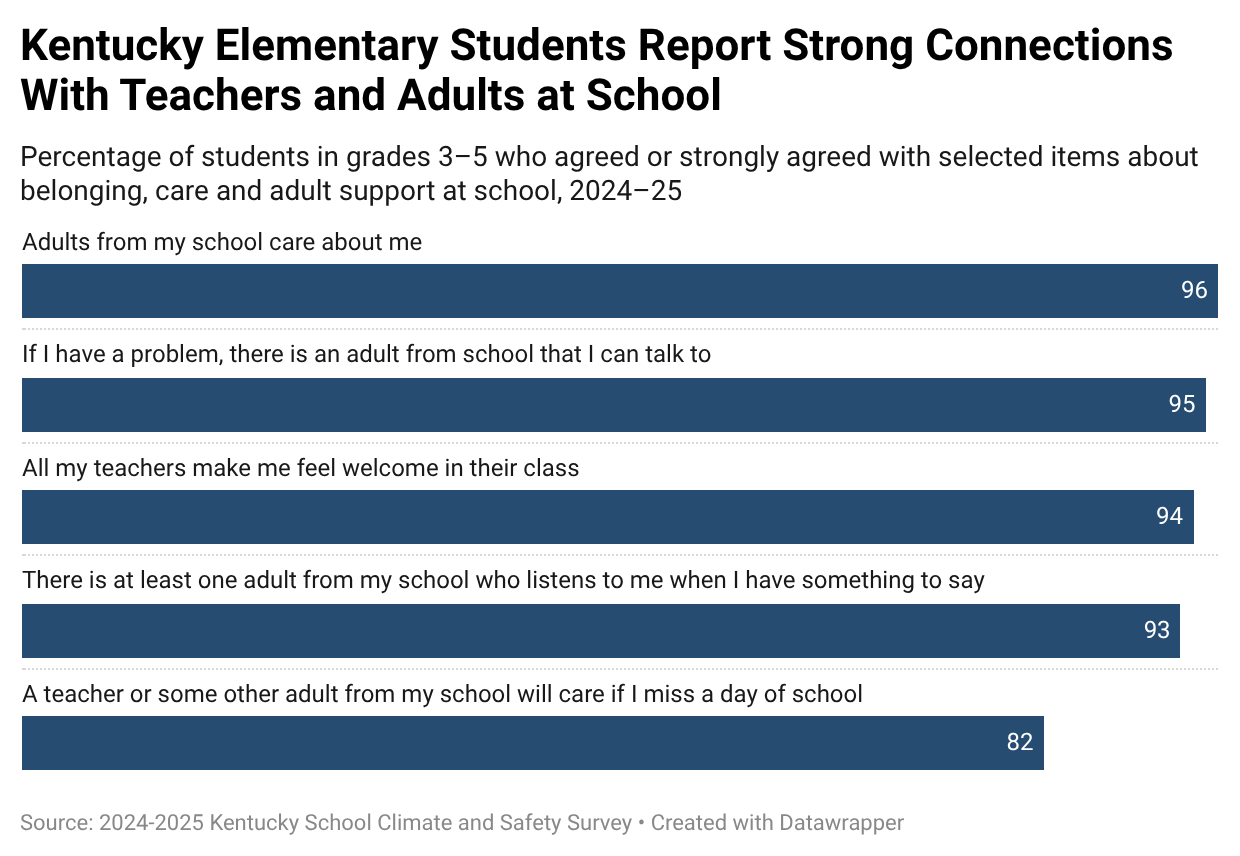
Figure 1. Kentucky elementary students report strong connections with teachers and adults at school. In 2024–2025, large majorities of students in grades 3–5 agreed or strongly agreed that adults at school care about them, listen to them, make them feel welcome and are available when they need support.
These findings are encouraging. Nearly all Kentucky elementary students surveyed said adults at school care about them, and 94% said their teachers make them feel welcome in class. Those relationships are an important part of what teachers make possible each day. Teachers do more than deliver academic content; they create classroom communities where students can feel known, supported and confident enough to participate, take risks and learn. These experiences can also help reinforce a student’s sense that they belong at school.
Teachers Help Students Build Skills That Last
Teachers also help students develop skills that reach beyond any one subject or test. Through discussion, problem solving, collaboration, reflection and authentic tasks, teachers give students repeated opportunities to communicate clearly, think critically, work with others and take greater ownership of their learning.
Research suggests that teachers influence much more than test scores. One study found that upper-elementary teachers had meaningful effects on students’ self-efficacy, happiness and classroom behavior,5 while another found teacher effects on student absences, suspensions, course grades and on-time grade progression.6 Their influence is not limited to what students know, but also includes how students experience school and develop as learners.
Kentucky’s Portrait of a Learner reflects this broader view of student success, and many districts have created local Portraits focused on skills such as critical thinking, communication, collaboration and engaged citizenship. A Portrait of a Learner is a set of knowledge and skills that local school districts create in partnership with communities to communicate their hopes for the learners in their schools. Across Kentucky, teachers are bringing these ideas to life through vibrant learning experiences that give students opportunities to apply academic knowledge, solve authentic problems, work with others and demonstrate what they know and can do in meaningful ways.
In Fayette County, our teachers are bridging the gap between science concepts and urban waste management by partnering with Live Green Lexington. In Shelbyville, teachers are bringing tabletop roleplaying games to life as students learn about Manifest Destiny and exhibit Portrait of a Learner skills. And in Morehead, teachers are connecting students with community members and discussing civic duty as they explore local historic archives together.
You can learn more about this incredible work at KDE’s Vibrant Learning Experiences webpage.
Why We’re Examining Teacher Well-Being in Kentucky
The evidence that teachers matter deeply is clear. If teachers shape what students learn, whether they feel they belong and the skills they develop for the future, then the conditions teachers experience at work matter, too.
Research has linked stronger teacher well-being with better teacher-student relationships, greater student motivation and more positive classroom experiences. Meanwhile, higher levels of burnout have been associated with teacher absenteeism and lower-quality interactions with students.7 The evidence on academic achievement is less conclusive, but the broader pattern is clear: how teachers experience their work can shape how students experience school.
Teacher well-being is therefore more than an employee or workforce issue. Supporting teachers’ ability to feel effective, connected and able to sustain the demands of their work is also part of supporting the students they serve.
Coming Up in the Series
When writing this post, I couldn’t help but think of the many superb educators who guided me through my K-12 career. This series is dedicated to understanding the current state of teaching in the Commonwealth for those incredible teachers who are currently in the profession and for those future teachers who will be entering the workforce in the coming years.
Our next post, “Teacher Turnover in Kentucky: What the Data Show,” will look at what teacher turnover actually means and what Kentucky’s data show about who stays, who moves and who leaves. We’ll examine the difference between school-level turnover and statewide workforce exits, how those patterns have changed in recent years and what the numbers can—and cannot—tell us about Kentucky’s teacher workforce.
1 Opper (2019). Teachers Matter: Understanding Teachers’ Impact on Student Achievement. RAND Corporation. Access the full report here.
2 Chetty, et al. (2014). Measuring the Impacts of Teachers II: Teacher Value-Added and Student Outcomes in Adulthood. American Economic Review. Access the full article here.
3 Emslander, et al. (2025). Teacher-Student Relationships and Student Outcomes: A Systematic Second-Order Meta-Analytic Review. Psychological Bulletin. Access the article here.
4 Kentucky Department of Education (2025). 2024–2025 Quality of School Climate and Safety Survey Results. Access the KDE historical accountability data here.
5 Blazar, D., & Kraft, M. A. (2017). Teacher and Teaching Effects on Students’ Attitudes and Behaviors. Educational Evaluation and Policy Analysis, 39(1), 146–170. Access the full article here.
6 Jackson, C. K. (2018). What Do Test Scores Miss? The Importance of Teacher Effects on Non–Test Score Outcomes. Journal of Political Economy, 126(5), 2072–2107. Access the article here.
7 Wartenberg, et al. (2026). How Strongly Is Teachers’ Burnout Related to Teacher Absenteeism, Teacher–Student Interactions, and Student Motivation and Achievement: A Meta-Analysis and Systematic Review. Review of Educational Research. Access the article here.