

The chronic absenteeism numbers we looked at in our last post were a wake-up call, particularly since these aren’t just numbers on a page, but real students walking into classrooms every day.
Our first post made it clear that low-chronic-absenteeism schools have basically disappeared, leaving nearly 80% of the state facing a pretty sobering new normal. While the state has set a clear goal to reduce that rate to 15% by 2029, we likely can’t get there without a fundamental shift in how we approach the problem.
While tracking data is critical, it is only one piece of the puzzle. The real solution lies in making stronger connections with students, families, and the community. At the end of the day, students don’t show up to school just to hit school attendance goals – they show up because they see value in what they’re learning when present and missed when they’re gone.
This is why the Kentucky Department of Education (KDE) is focused on grassroots approaches and local solutions. Along with the usual resources they provide to districts, they’re launching new projects focused on local efforts and human connection.
The “Attendance Matters!” Movement
You may have already noticed this shift on your daily commute. During the 2024-2025 and 2025-2026 school years, the state has rolled out its new public awareness campaign, “Attendance Matters: We Missed You in School!” and most recently, “Attendance Matters: You Belong!” It’s hard to miss on billboards, on the radio, and even posted across local buses and bus shelters.
In the past, the response to chronically absent students was largely punitive – truancy notices, legal letters, and court threats that often push away the very families we need to reach. 1An Oregon study piloting trauma-informed practices related to attendance cited a shift in how they approached the issue, stating truancy letters were redesigned to contain more positive messages via postcards sent to students and their families by teachers and administrators. One teacher from the study reported…
“One of the things that used to just drive me nuts is students that were either tardy to class or had a lot of absences. And I wouldn’t rip on them when they would come in, but I have a look … of disappointment when you walk in late. And now my view is, when they come in, I celebrate —“Hey, thank you for showing up! I’m glad you’re back. I know you’ve been gone a couple of days, but we really missed you.”
The KDE campaign mirrors these efforts by investing in strategies that promote stronger connections built on a simple idea – students shouldn’t show up out of fear of getting in trouble; they should show up because they know they matter.
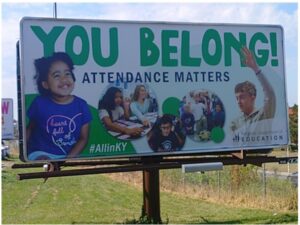
Figure: The Kentucky Department of Education’s “You Belong! Attendance Matters” billboard.
Of course, policies are necessary, but the department also created a flexible toolkit that schools, businesses, and local leaders can customize for their own communities. But the best part of the campaign isn’t the ads on marquees or inside buses, it’s how the state is getting the students themselves involved.
Partnering with the Student Technology Leadership Program (STLP), Kentucky launched a statewide video and poster contest for K–12 students. The challenge was simple – show us what belonging looks like and tell us why showing up matters. The response was overwhelming with 75 entries from 36 districts. First and Second place winners at the elementary, middle and high school levels were recently celebrated at the Student Technology Leadership Program (STLP) State Championship on April 24.

1st Place Winner: The retro-gaming-inspired “Level Up By Showing Up” attendance poster for Phelps Elementary in Pike County.
Winners include:
| Entry Type | Elementary | Middle | High |
| Poster | 1st Place – Pike County Schools (Phelps Elementary)2nd Place – Lawrence County Schools (Louisa East Elementary) |
1st Place – Harrison County Schools (Harrison County Middle)2nd Place – Woodford County Schools (Woodford County Middle) |
1st Place – Lawrence County Schools (Lawrence County High)2nd Place – Harrison County Schools (Harrison County High) |
| Video | 1st Place – Laurel County Schools (Cold Hill Elementary)2nd Place – Somerset Independent Schools (Hopkins Elementary) |
1st Place – Henderson County Schools (North Middle)2nd Place – Hopkins County Schools (Browning Springs Middle) |
1st Place – Pineville Independent Schools (Pineville High)2nd Place – Trimble County Schools (Trimble County Jr/Sr High) |
Giving students the spotlight was a smart move. Adults can talk about attendance metrics all day, but the message hits differently when it comes straight from the students.
All of these efforts aim to rally local community buy-in, transforming attendance from a compliance conversation into a shared point of pride. Local businesses, community leaders, educators and even students are joining forces to actively celebrate “showing up.”
Strategic Partnerships: Matching Evidence-Based Solutions to Local Contexts
Launching a statewide attendance campaign was a huge step for raising public awareness, but the leadership at KDE knew the support couldn’t stop there. The underlying reasons why kids miss school—and the community resources available to help them—look completely different from one district to the next. Because these challenges are so localized, the solutions have to start at the ground level.
This realization sparked a new partnership between KDE and the Regional Educational Laboratory (REL) Appalachia. The goal of this team-up is to turn big-picture, state-level insights into practical, everyday tools that help local district teams figure out exactly why their specific students are missing school.
As part of a pilot program KDE and REL teams are working shoulder-to-shoulder with districts to build a realistic roadmap that any school struggling with high absenteeism can eventually use. A big part of the challenge is in teaching districts to use the right data. Many schools and districts rely on end of year or even end of month data that is reactive by nature and not very effective for timely intervention.
To fix this, 2pilot districts are completely rethinking their data readiness, moving past outdated, lagging numbers and shifting toward real-time tracking. Training on existing streaming data lets schools catch attendance slips quickly, rather than weeks down the road.
Currently, five school districts representing high-need, highly resilient communities across eastern and southeastern Kentucky are leading the charge. They are participating in structured learning sessions and ongoing coaching cycles, giving district teams a safe space to share their data, challenges, failures, and successes. Ultimately, they aren’t just learning standard attendance strategies, they are building sustainable, everyday support systems tailored entirely to their unique needs and assets.
Join the Conversation
How is your district rethinking the attendance conversation to include a focus on genuine belonging and celebrating “showing up”? We’d love to hear your thoughts—drop a comment below to share the creative strategies or local initiatives making a difference in your district!
Coming Up in the Series
In part three of the Chronic Absenteeism blog series, we take things a step further. School and grade level attendance reports can tell us who is missing, but we can’t stop there. In the next post we dive deeper into the data to uncover the complexities and often-overlooked contributing factors the baseline numbers don’t show. Stay tuned!
Interested in learning more about KDE’s chronic absenteeism toolkit? Visit the Attendance Matters webpage for customizable resources.
Follow Attendance Matters! A Collaborative Effort to Address Chronic Absenteeism in Kentucky to access REL Appalachia’s blog post on the KDE/REL partnership.
1Oregon Department of Education. (2019). The use of implementation science to study trauma-informed practices: A closer look at implementation in two Oregon schools: Findings from a three-year pilot study. Oregon Legislature. https://www.oregonlegislature.gov/citizen_engagement/Reports/2019-DOED-TIP-Pilot.pdf
2Pilot school districts include: Harlan County, McCreary County, Montgomery County, Wayne County and Wolfe County.