

For most of us who attended public school, handling an absence was pretty straightforward. If you were out, your parents likely sent you back to school, sometimes with a note, and that was that. Attendance, for the most part, was handled at the school level between families and the attendance clerk.
But for many states, things changed completely when Congress passed the Every Student Succeeds Act (ESSA), requiring states to track more than just test scores. States became responsible for choosing an additional indicator to measure school quality or student success. The vast majority of states chose the exact same non-academic metric: chronic absenteeism.
If you’ve looked at Kentucky’s School Report Card over the last few years, you’ve probably noticed attendance and chronic absentee numbers. But up until now, they were purely informational and didn’t affect a school’s overall performance accountability rating.
That is changing. Recent Kentucky legislation (House Bill 257)1 updates how student attendance impacts a school’s public standing by pulling the chronic absenteeism indicator directly into the state’s assessment and accountability scoring system, replacing the Quality of School Climate and Safety Survey Indicator.2
The Reason Behind the Shift
So, why did national reporting push states toward this metric in the first place? First, national data has proven that tracking chronic absence in the early grades is the single most accurate predictor of whether a student will read on grade level by third grade, or eventually drop out of high school. It flags a kid who is sliding off track long before standardized test scores ever catch it.
Second is the power it has in spotlighting hidden gaps in student support. Federal rules require schools to break this attendance data down by specific student groups—like students with disabilities, English language learners, and economically disadvantaged students. High chronic absences in one specific group alerts schools and districts that there may be a systemic barrier that needs to be addressed.
By looking at attendance through this lens, the baseline goal fundamentally changed from punishment to support.
Making Sense of New Attendance Legislation
While House Bill 257 reshapes how attendance factors into a school’s performance metrics, it is just one piece of a much larger puzzle. With multiple legislative updates hitting all at once, it is easy to see why families and educators might be confused.
The key to unlocking this distinction lies in two terms (truancy and chronic absenteeism) which are often used interchangeably despite state tracking and federal reporting systems treating them very differently.
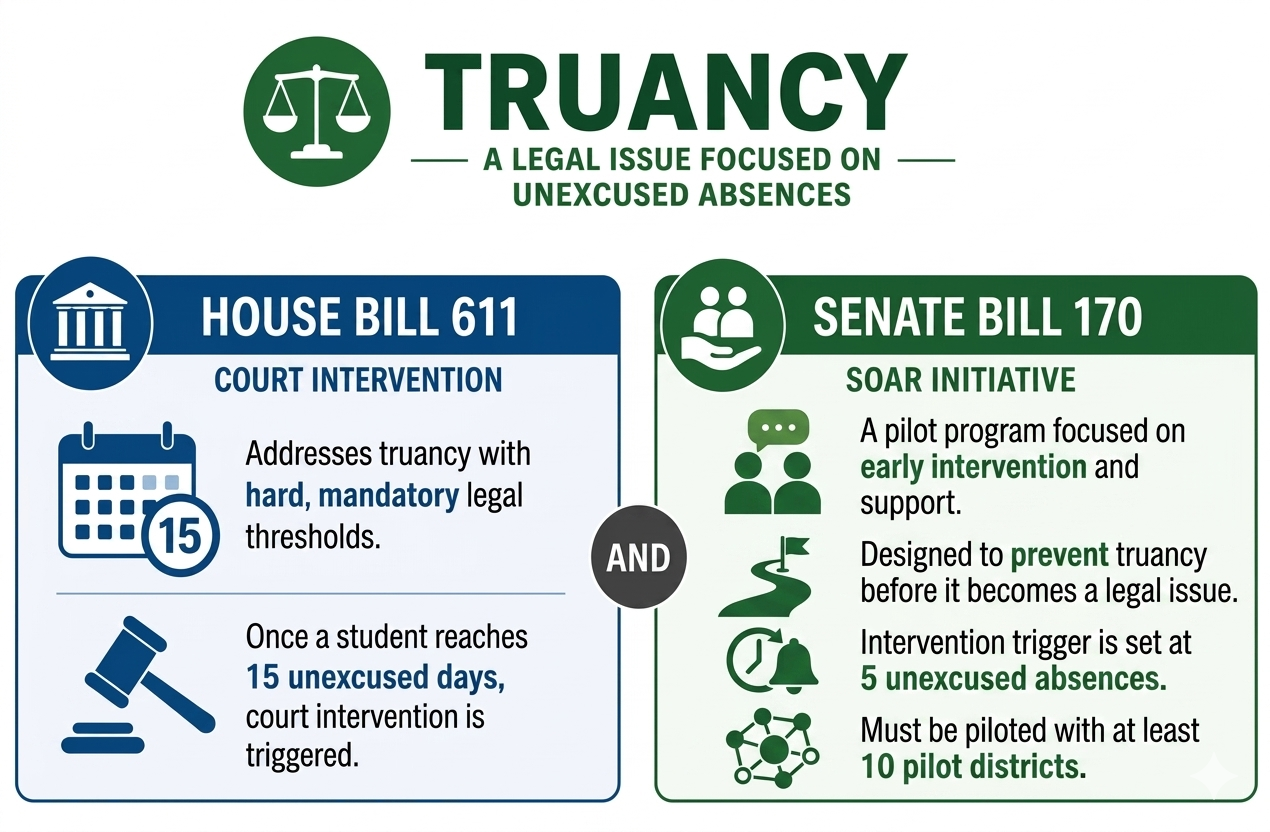
The easiest way to see the difference is that truancy is strictly a legal issue focused on unexcused absences. Laws like House Bill 611 and Senate Bill 170 both target truancy, but from different angles, with House Bill 6113 focusing on court intervention, addressing the problem with fixed, mandatory legal thresholds once a student hits 15 unexcused days, and Senate Bill 1704 proactively setting up a pilot program (the Supporting Opportunities for Accountability and Restoration Program or SOAR) to address the issue from an early intervention and support angle.
On the flip side, chronic absenteeism looks at the big picture, counting all student absences, regardless of the reason with only one metric: Is the student in the classroom or not? Once a child misses 10% of the school year for any reason—whether it’s strep throat, a family crisis, an out-of-school suspension, or just skipping class—they are flagged as chronically absent.
While a doctor’s note may satisfy local truancy rules to keep a family out of a courtroom, it can’t erase missed instructional time under chronic absenteeism.
Why Legal Fixes Are Likely Not Enough
While policy approaches may be parallel as it relates to student absences broadly, they may introduce a major timing challenge for schools relying on more traditional approaches to the attendance problem. For many schools, addressing attendance can seem like a waiting game as they watch to see if new interventions actually move the needle. Perhaps some schools feel they have exhausted all the tools in their toolbox and may be waiting for a student to stack up enough unexcused days to legally cross the line, at which point the district moves forward on the truancy pathway.
This is where the two systems may present an overlapping dilemma. For example, by the time a school gathers enough documentation for a court referral, the student could have already missed weeks of school and crossed the 10% chronic absenteeism threshold. Schools can no more punish away a medical emergency or a chronic lack of transportation than a judge can court-order a solution to those systemic barriers. A more successful framework would likely require a structural pivot toward proactive, community-based prevention where schools look closely at specific students and their needs.
State data shows that while a school’s general attendance rate might look perfectly stable, absentee rates for many students are high due to family, community, and even regional barriers, including transportation issues and housing instability. This presents an opportunity for school-community-family partnerships to work together on solutions to leverage local resources to address a school community’s specific challenges.
The Path Forward
At the end of the day, moving the needle on student attendance requires everyone rowing in the same direction. Lasting improvement only happens when state policies, local accountability, and everyday classroom practices are fully aligned. The KDE champions prevention and early intervention through accountability measures, the strategic plan, practical guidance, and statewide awareness campaigns as you have seen throughout this series. As a result, districts and schools are much better positioned to respond proactively, before a student falls behind, resulting in the court system being used strictly as a last resort. Ultimately, shifting away from reactive punishments isn’t just about protecting a school’s data profile; it’s about building a unified, encouraging system where every student feels like they are missed, belong and are supported enough to show up.
That sense of support centers heavily on school climate. When a school feels safe, welcoming, and connected, chronic absenteeism naturally drops because more students actually want to be there. But we can’t build a healthy, vibrant school climate for students without looking at the adults in the building.
With that in mind, our next series will shift focus to an equally critical piece of the school climate puzzle: the health, wellbeing and stability of our educators. We will look closely at the challenges our educators are currently facing and connections with how supporting staff is an essential first step to building a school environment where both teachers and students want to be at school.
Join the Conversation
With chronic absenteeism factoring directly into state accountability, the old ‘doctor’s note fix’ isn’t enough anymore—at the end of the day, an empty seat is an empty seat when it comes to lost instructional time. What has been the biggest hurdle or the most successful mindset shift your community has experienced when moving from tracking truancy to fighting chronic absenteeism? Share some of your insights in the comments!
1 Kentucky General Assembly. (2026). House Bill 257: An act relating to education accountability and chronic absenteeism.Read more about HB257 here.
2 State accountability indicator that meets federal requirements for Comprehensive Support and Improvement (CSI) designation. Chronic Absenteeism replaces Climate and Safety Survey Data for the CSI calculation to meet federal requirements.
3 Kentucky General Assembly. (2024). House Bill 611: An act relating to truancy. Read more about HB611 here.
4 Kentucky General Assembly. (2026). Senate Bill 170: An act relating to status offenses (Supporting Opportunities for Accountability and Restoration Program).Read more about SB170 here.